
Hearing loss brings a lot of sadness, and it would be hypocritical not to talk about it. Recently, I shared a link on the Crônicas da Surdez Facebook page to a 2012 post titled “Hearing Loss Also Saddens Me.”
I was surprised to see that nearly 20,000 people viewed it just because of that title, even though it was an old post. That got me thinking about how much I’ve changed since then. Later, while scrolling through my phone, I came across a photo that perfectly captures exactly who I was back in 2012.
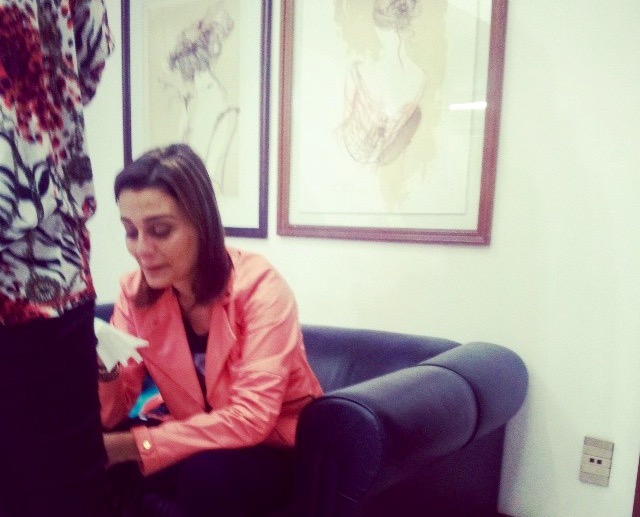
The down-in-the-dumps photo

On that day, I was at a restaurant in Campos do Jordão after giving a lecture at FORL, accompanied by a group of speech therapists and my mother, who took the photo.
Completely exhausted from a full day of tracking lips to read them, I still dared to accept a dinner invitation. Naturally, I couldn’t keep up with multiple people talking at once in a noisy, dimly lit restaurant. I ended up falling asleep right there at the table while the conversation flowed around me.
Looking back, I feel a deep sadness for that version of myself, because today my life is completely different. Going out to dinner is no longer a sacrifice—an activity that drains me and sends me home feeling miserable for missing out on everything. In 2021, going out for a meal is a genuine pleasure and a joy. I look at that photo and think about how painful it was to deal with constant frustration during moments that should have been fun and happy.
How do we handle it?
Where do we get our strength from? How do we move on with our lives without surrendering to the loneliness and isolation that hearing loss brings?
Today, everything is much easier for me because of my cochlear implants, but I know that thousands of you reading this still live with those exact feelings—which is why I believe it is so important to talk about them. We deserve immense credit for our ability to keep moving forward despite the heavy psychological burden of hearing loss. The secret is never to give up and to always seek out everything technology has to offer.
Hearing loss in adulthood
Living with hearing loss means existing in a state of constant exertion: the effort to follow conversations, the effort to hear, and the effort to process what was said.
It is the effort not to fall apart at insensitive jokes, the effort not to succumb to sadness, and the exhausting routine of reading lips all day at work only to come home and keep reading the lips of your own family. It is the effort to find happiness somewhere between sound and silence, the effort to adapt to hearing aids, and the effort to adapt to a cochlear implant.
Every hearing person I know thinks this is easy—and they only change their minds when hearing loss happens to them.
Aqui está a versão reescrita: direta, natural e rigorosamente ajustada para usar apenas o termo hearing loss (removendo qualquer menção a deafness ou derivados), além de corrigir os erros de digitação e gramática do original.
Recently at Sonora, I met a patient who had just received a cochlear implant, and we started talking. His gaze was exactly like mine back in 2012: alert, wide-eyed, staring intensely at mouths, and constantly scanning to see if he was missing something.
I told him: “In a few months, once your CI is activated and you get a bit used to it, you will relax. You will lose this constant need to be on high alert.”
He looked at me with an expression of someone who felt completely understood and said: “I’m just so tired. Every day, I come home exhausted. I try to explain to my wife that it’s not that I don’t want to pay attention to her, I just physically can’t take it anymore after a long day of work.”
Our conversation made me think of that photo, taken moments before my first cochlear implant activation on November 11, 2013. I had no expectations and was prepared for the worst. But deep down, I desperately wanted it to free me from two things: the exhaustion and the isolation caused by hearing loss.
I believe some of the psychological impact that hearing loss leaves behind stays with us for life. It is not easy to live with a condition that negatively impacts communication and interaction in every single aspect of life: at home, at work, with friends, during travel, in leisure time, and in romantic relationships.
The deepest sadness of hearing loss
The greatest sadness that hearing loss brought me was the feeling of being a prisoner within myself—a prisoner inside my own mind.
I was trapped in a lonely bubble of silence that I couldn’t break, not even with a sledgehammer. I had the distinct feeling that my body and mind were at the top of a very high tower, and no matter how much I let down my hair, it could never reach the ground.
Because of this, I believe we must face this sadness with courage. I had great results with my cochlear implants, but it wasn’t an easy decision, and the adaptation process was no piece of cake. The pain of remaining stuck in that silence was simply greater than the fear of trying the implant, and that is what drove me forward. This same reasoning should motivate those who need to use hearing aids but find themselves paralyzed by anger.
To this day, I still deal with tinnitus—although after getting two implants, it decreased by 80%. Some days it still really annoys me. I wish it would disappear completely, but it will likely stay with me until the end. In fact, one of my strongest childhood memories is of this tinnitus. It feels like the hearing loss never fully gives me a truce, since the tinnitus is directly connected to it.
Hearing loss and music
If someone asked me what sadness my hearing loss brings me today, the only thing that comes to mind is not being able to perceive all the beauty and nuances of music.
The pleasure of listening and being able to understand lyrics—not always, but most of the time—is already more than enough for me. However, it is frustrating to go to a piano performance and hear the notes as if they were flat and monotonous. It is annoying to know that in an environment with classical music playing, I won’t perceive it the way people with normal hearing do. Music is the only topic that still makes me feel a disconnect compared to those who hear naturally.
As Caio Fernando Abreu once wrote: “There is always something missing. Keep it painlessly, although, in secret, it hurts.”
Shall we talk about it?
I know how difficult it is to talk about the blues of hearing loss with the people around us, especially because they don’t experience it themselves. It’s like talking about betrayal with someone who has never been betrayed, or talking about dieting with someone who has never needed to lose weight.
But it is necessary to talk about it because, as a phrase I read once says, “the word kills the thing.” When we verbalize what bothers us, that “thing” seems to lose its magnitude and its power over us.
Perhaps I will spend the rest of my days cataloging, reviewing, and archiving the feelings related to everything that hearing loss has caused me, made me go through, and continues to put me through.
Continue lendo nesta categoria
Hearing Loss
- Hearing Loss Support Group in Portuguese: CLUBE Surdos Que Ouvem
- Hearing Loss: What I Wish Someone Had Told Me
- Top 3 Alarm Clocks with BED SHAKER for Hearing LOSS in 2026
- I LOST MY HEARING in 2026
- Top 10 FRUSTRATIONS of Living with HEARING LOSS in 2026
- Advice for MOTHERS of children with HEARING LOSS in 2026
- Tips for ELDERLY people with HEARING LOSS in 2026
- How to adapt to the COCHLEAR IMPLANT in 2026
- Bilateral COCHLEAR IMPLANT: Top reasons to do in 2026
- 6 ESSENTIAL Products for people with HEARING LOSS in 2026
- The Social and emotional impacts of HEARING LOSS in 2026
- Letter to my mother about my HEARING LOSS
- 5 SECRETS to deal with HEARING LOSS in 2026
- Your LOVE LIFE when you have HEARING LOSS in 2026
- 8 books for KIDS with HEARING LOSS in 2026
- What it’s like to HEAR with a COCHLEAR IMPLANT in 2026
- 5 questions to ask yourself before getting a COCHLEAR IMPLANT
- Top 5 Marketing mistakes of the hearing industry in 2026
- Are you ASHAMED of your HEARING LOSS?
- The BEST HEARING AID in 2026: Advices from a HEARING AIDS USER